
Lecture 13: Uncovering Others' Private Information
Last time we looked at static games of incomplete information: games in which players had private information that they acted on, but because the games were one-shot games, there was no opportunity to learn about others’ hidden information, nor to communicate one’s own information to the other player. This week we’ll look at dynamic games of incomplete information: that is, games which take place over time, and which in the course of game play may (or may not!) reveal private information. This is our last, and most complex, class of games; and also the most interesting and realistic.
The real world has lots of examples of relationships with asymmetric information. Here are a few:
- You get a text from a politician you admire asking for a donation. If it’s really them, you’d like to give them the money. But it could be a text scam. What do you believe?
- You’re playing poker. You know the strength of your hand, and each of the other players knows the strength of theirs. You can bid aggressively, or cautiously; how you bid sends a signal to the other players of how strong your hand is. Of course, you can “bluff” – that is, bid aggressively even if you have a weak hand – so your signal may or may not be accurate.
- You’re applying for a job; you know how qualified you are for the job, but the employer doesn’t. You would of course like the employer to believe you’re highly qualified for the job, but that would be true of both a qualified and unqualified worker; is there some way you can convince the employer of your skills?
- A used car dealership lists a car for sale. It might be in great shape, or it might have hidden mechanical difficulties. As a buyer, you’d pay different amounts for different qualities of car; how can you know what the true value of the car is?
There are a million varieties of games of this sort. For this course, we’ll focus on situations in which one player has private information, and they move first; the second player then has to choose what to believe about the private information, based on that action. Formally:
- Nature will choose what “type” Player 1 (the “informed” player) is
- Player 1 will discover their type, and choose an action
- Player 2 (the “uninformed” player) will observe Player 1’s action, but not their type, and form beliefs about Player 1’s type based on the action they took
- Player 2 will choose the best action they can, based on their beliefs and the action Player 1 took
We’ll get to some examples soon enough, but before we do we need a bit of a math review on Bayes’ Rule and conditional probabilities.
Bayes’ Rule and Conditional Probabilities
Suppose you were interested in the fraction of people who were going to vote for a Democrat in an election in a “red state” where most of the people are Republican.
The $10 \times 10$ graph below represents 100 hypothetical voters. The population proportion of Democratic (blue) voters is initially 40%: that is, 40 of the 100 voters are blue, and 60 are red.
The smaller rectangle, though, represents likely voters. What fraction of those are blue? The conditional probability of $A$ occurring, given that we know $B$, is \(\text{Prob}\{A\ |\ B\} = \frac{\text{Prob}\{A \text{ and } B\}}{\text{Prob}\{B\}}\) In this case, “event $A$” is “voter is blue,” while “event $B$” is “voter is likely to vote.” Therefore $\text{Prob}\{A\ |\ B\}$ is the probability that a voter is blue, given that they’re in the group of likely voters (i.e. the smaller rectangle). So in this case, we have \(\text{Prob \{Blue | Likely\}} = \frac{\text{Prob \{Blue and Likely\}}}{\text{Prob \{Likely\}}}\) In other words, it’s the number of blue likely voters divided by the total number of likely voters (blue and red).
Bayes’ Rule is another way of writing conditional probabilities, but it adds a bit of insight: formally, it states \(\text{Prob}\{A\ |\ B\} = \frac{\text{Prob}\{B\ |\ A\} \times \text{Prob}\{A\}}{\text{Prob}\{B\}}\) Technically, these are the same statement, since \(\text{Prob}\{A \text{ and } B\} = \text{Prob}\{B\ |\ A\} \times \text{Prob}\{A\}\) but there’s a bit of intuition in Bayes’ rule that’s worth stating: in this context, it would read \(\text{Prob \{Blue | Likely\}} = \frac{\text{Prob \{Likely | Blue\}} \times \text{Prob \{Blue\}}}{\text{Prob \{Likely\}}}\) In other words, the probability that someone is blue and a likely voter is the probability they’re blue, times the fraction of blue voters who are likely voters. The math works out the same, but the intuition behind the formula will help us later on, because where we’re going to use this is in answering the question: Given that I see you behaving in a certain way, what do I think the likelihood is you have certain private information? In other words: given I’m at an information set, so I don’t know for sure which node I’m at, what do I believe is the probability I’m at each node?
In the games we’re about to study, the private information plays the role of “blue” and the action plays the role of “likely voter.” So the probability of each type is the prior, which comes from Nature, and the probability of an action given a type is just Player 1’s strategy. That’s why this form is so useful: it builds beliefs out of exactly the things that define the game.
Strategies and Consistent Beliefs
To make this concrete, consider the following game:
Game 13.1: I don’t have a story for this one yet, but I will someday
I wish I had a cute story for this one, but I kinda don’t; let’s just think about a simple abstract game:
- First, Nature chooses Up or Down
- Second, Player 1 chooses Up or Down
- Last, Player 2 chooses Left or Right
The information is a little different than we saw last class, though: Player 1 always observes Nature’s move. However, Player 2 can only observe if both Nature and Player 1 chose Up; but otherwise Player 2 doesn’t know what has happened. We see this as the information set connecting the three lower orange nodes in this diagram:
In this case, Player 2’s strategy has to specify what to do after $(\pnat{U},\pone{U})$, and what to do if the information set is reached. In order to decide what they should do at the info set, we need to specify their beliefs about how likely each of the three nodes is. We label those beliefs in this case with the Greek letters $\alpha$, $\beta$, and $\gamma$; and we can use Bayes’ rule to figure out what they are for each strategy that Player 1 might play!
Let’s start with Player 1 always choosing Up: that is, $\pone{UU^\prime}$. In that case the only way that the information set is reached is if Nature chose $\pnat{D}$ and Player 1 chose $\pone{U^\prime}$; hence $\ptwo{\alpha = 0}$, $\ptwo{\beta = 1}$, and $\ptwo{\gamma = 0}$.
Now suppose Player 1 always chooses Down, playing $\pone{DD^\prime}$. In that case there are two ways that the information set might have been reached: either Nature chose $\pnat{U}$ and Player 1 chose $\pone{D}$, or Nature chose $\pnat{D}$ and Player 1 chose $\pone{D^\prime}$. Since Nature chooses $\pnat{U}$ with probability ${1 \over 4}$, Player 2’s beliefs would be $\ptwo{\alpha = {1 \over 4}}$, $\ptwo{\beta = 0}$, and $\ptwo{\gamma = {3 \over 4}}$.
More generally, we say that a player’s beliefs are consistent with the strategies being played by other players if they are the beliefs which would be found using Bayes’ rule given the strategies of the other player, and the probabilities Nature places on different states of the world.
This leads us to our definition of equilibrium in this kind of game, which we will call a Perfect Bayesian Equilibrium:
Definition (Perfect Bayesian Equilibrium (PBE)): A strategy profile $s$ and a set of beliefs over all information sets constitute a PBE if (a) each player's strategy is optimal given the strategies of the other players, and their beliefs; and (b) all beliefs are consistent with Bayes' rule whenever possible.
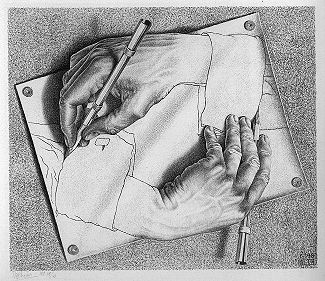
I think of this equilibrium, perhaps even more than others, as an example of a self-perpetuating system, not unlike M.C. Escher’s lithograph “Drawing Hands”:
In this game, the PBE is pretty easy to find, because Player 1 has a dominant strategy: to play $\pone{UD^\prime}$, which always gives a payoff of 5. Knowing this, Player 2 will believe that if the information set has been reached, the history of the game must have been $(\pnat{D},\pone{D^\prime})$: that is, $\ptwo{\alpha = 0}$, $\ptwo{\beta = 0}$, and $\ptwo{\gamma = 1}$. Given those beliefs, Player 2’s best response at the information set is $\ptwo{R^\prime}$, which gives a payoff of 5 rather than 0. After $(\pnat{U},\pone{U})$, Player 2’s best response is $\ptwo{L}$, which also gives a payoff of 5 rather than 0. So the PBE of this game is $(s = (\pone{UD^\prime},\ptwo{LR^\prime}),\ptwo{(\alpha,\beta,\gamma) = (0,0,1)})$.
When Bayes’ Rule Doesn’t Always Work
In the definition above, there’s a bit of a cryptic ending to an otherwise straightforward statement: it says that beliefs must be consistent with Bayes’ rule whenever possible. What does that mean? Let’s find out.
Game 13.2: Are you James Talarico or not?
It’s fall 2026, and that means you’ve gotten a bunch of texts like this purporting to be from James Talarico, who was running for Senate in Texas:
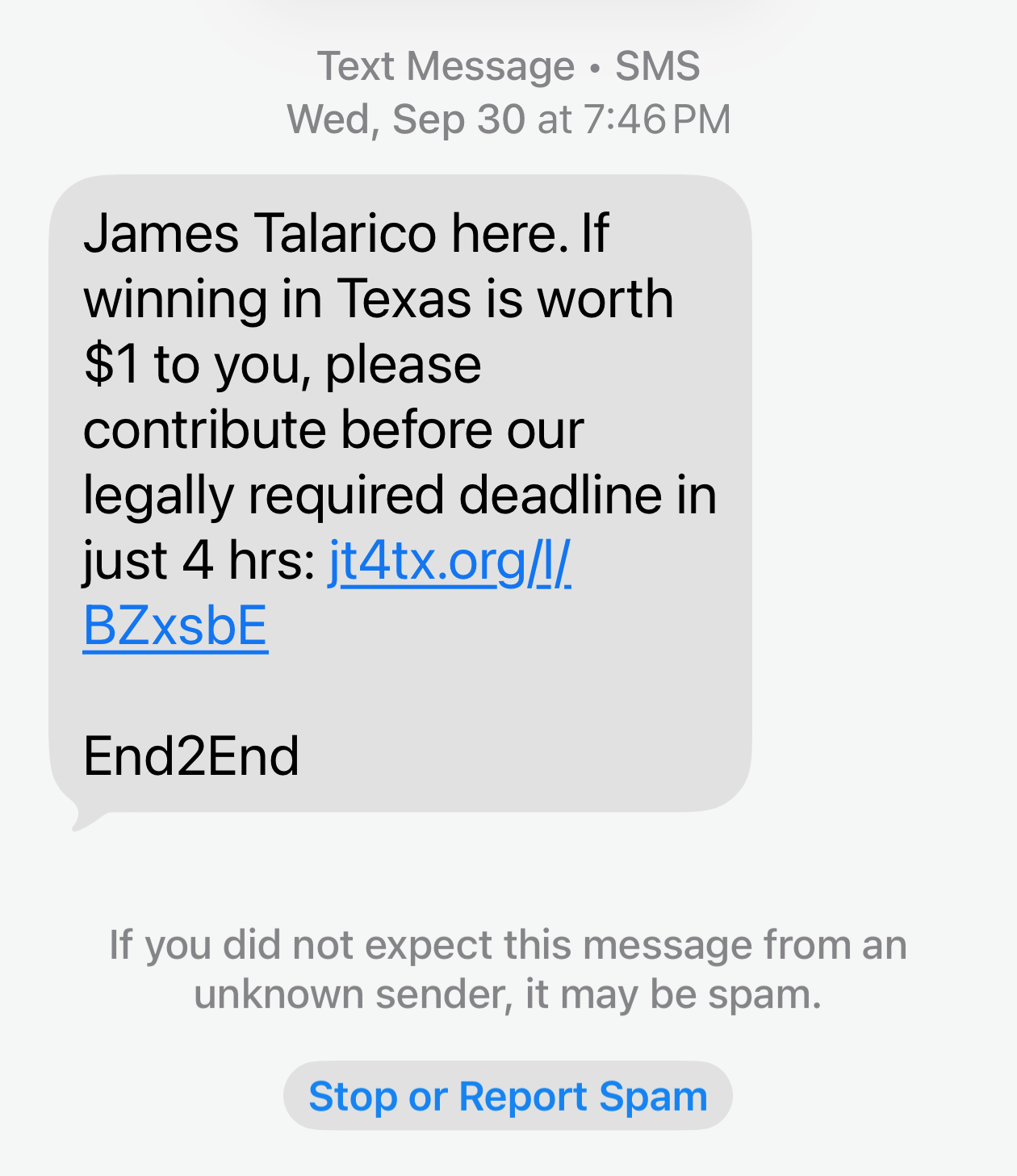
Suppose for the sake of argument that you were a big supporter of what Talarico stands for, and that if this really was him you’d like to give him a dollar; but it might not be him, but instead a bot trying to get your money by sending you to a scam web page.
So here the question we’re trying to answer is: conditional on receiving this text, with what probability do you believe it’s actually the Talarico campaign texting you? Should you give the dollar? And what’s the equilibrium of the game?
We’ll model this as a Bayesian game, as follows: Nature chooses first whether someone is a Talarico campaign worker or a scammy bot; that person is Player 1. They’re a Talarico worker (“type $T$”) with probability $p$, and a scammer bot (“type $B$”) with probability $1 - p$. Player 1, knowing their type, then decides whether to “send a text” $(\pone{S})$ or “don’t send a text” $(\pone{D})$. To disambiguate, we’ll say that a type-$T$ player is choosing between $\pone{S}$ and $\pone{D}$, while a type-$B$ player is choosing between $\pone{S^\prime}$ and $\pone{D^\prime}$. If they don’t send a text, the game ends. If they do, you can donate ($\ptwo{Y}$) or not ($\ptwo{N}$). Note that you can’t condition your move on their type: you can only see that you’ve received a text.
The payoffs are as follows:
- if they don’t send a text, both they and you get a payoff of zero.
- if they send a text and you don’t donate (choose $\ptwo{N}$), they get a payoff of $\pone{-1}$ and you get a payoff of $\ptwo{0}$.
- If they send a text and you do donate (choose $\ptwo{Y}$), they get a payoff of $\pone{2}$. You get a payoff of $\ptwo{1}$ if it’s a legit text from the campaign, and a payoff of $\ptwo{-3}$ if they’re a bot.
The tree representation of the game may be seen as follows. Note that it “begins” with the move of Nature in the middle, who chooses $\pnat{T}$ with probability $\pnat{p}$ and $\pnat{B}$ with probability $\pnat{1-p}$. You can adjust $\pnat{p}$ using the slider on the right.
In this game, there’s a single information set: someone has sent you a text, but you don’t know who! We’ve labeled the beliefs at the node of this information set $\ptwo{q}$ and $\ptwo{1-q}$: that is, conditional on receiving a text, you believe it’s legit with probability $\ptwo{q}$.
Let’s think about how you should act, based on this belief. If you choose $\ptwo{Y}$, you’ll get a payoff of $\ptwo{1}$ with probability $\ptwo{q}$, and a payoff of $\ptwo{-3}$ with probability $\ptwo{1-q}$. If you choose $\ptwo{N}$, you’ll get a payoff of $\ptwo{0}$ no matter what. Therefore you should choose $\ptwo{Y}$ if \(\begin{aligned} 1q + (-3)(1-q) &> 0\\ q &> 3 - 3q\\ 4q &> 3\\ q &> \tfrac{3}{4} \end{aligned}\) We’ll proceed using guess and check. In particular, we’ll look at the four possible strategies of Player 1; what beliefs $q$ would be consistent with those strategies; what you would therefore do for that value of $q$; and whether, given that, the initial strategy is in fact a best response to what you would do.
Case 1: $\pone{s_1 = SD^\prime}$
First, suppose only Talarico sends texts, and bots don’t – that is, Player 1 plays the strategy $\pone{SD^\prime}$. In this case, the only one who would have sent you a text is Talarico, so conditional on receiving a text, you know Nature chose $\pnat{T}$: therefore $\ptwo{q = 1}$.
Given this belief, your best response is $\ptwo{Y}$, since that gives you a payoff of $\ptwo{1}$ rather than $\ptwo{0}$.
So, the last thing we have to do is to ask if Player 1 would really want to play $\pone{SD^\prime}$ if you’re choosing $\ptwo{Y}$; and the answer is no! In particular, if you’re going to respond to a text by donating, the bot would want to choose $\pone{S^\prime}$ and get a payoff of $\pone{2}$, rather than $\pone{D^\prime}$ and get a payoff of $\pone{0}$.
Therefore, $(s = (\pone{SD^\prime},\ptwo{Y}),\ptwo{q = 1})$ is not a PBE: while Player 2’s beliefs are consistent with Player 1’s strategy, and Player 2’s strategy is optimal given Player 1’s strategy and their beliefs, Player 1’s strategy is NOT a best response to Player 2’s strategy.
Case 2: $\pone{s_1 = DS^\prime}$
Next, suppose only bots send texts, and Talarico doesn’t – that is, Player 1 plays the strategy $\pone{DS^\prime}$. In this case, the only one who would have sent you a text is a bot, so conditional on receiving a text, you know Nature chose $\pnat{B}$: therefore $\ptwo{q = 0}$.
Given this belief, your best response is $\ptwo{N}$, since that gives you a payoff of $\ptwo{0}$ rather than $\ptwo{-3}$.
Again, the last thing we have to do is to ask if Player 1 would really want to play $\pone{DS^\prime}$ if you’re choosing $\ptwo{N}$; and again the answer is no! If you don’t donate, nobody wants to text you and get a payoff of $\pone{-1}$. So $(s = (\pone{DS^\prime},\ptwo{N}),\ptwo{q = 0})$ is also not a PBE.
Case 3: $\pone{s_1 = SS^\prime}$
OK, so what if everyone sends you a text? In that case, the fact that someone sent you a text conveys no information: if Nature chose type $\pnat{T}$ with probability $\pnat{p}$, then $\ptwo{q} = \pnat{p}$.
What’s your best response now, as Player 2? Well, it depends on what $\pnat{p}$ is. We established before that you’d only donate if $\ptwo{q > {3 \over 4}}$. So if $\pnat{p > {3 \over 4}}$, then $\ptwo{q > {3 \over 4}}$ and you’ll donate; but if $\pnat{p < {3 \over 4}}$, then $\ptwo{q < {3 \over 4}}$ and you won’t. So, we have two possibilities to check for equilibrium.
- If $\pnat{p > {3 \over 4}}$ your optimal response is to donate; given the fact that you would donate, both Talarico and any bot would want to send you a text. So, for any $\pnat{p > {3 \over 4}}$, there is a PBE: $(s = (\pone{SS^\prime},\ptwo{Y}),\ptwo{q = \pnat{p}})$.
- If $\pnat{p < {3 \over 4}}$ your optimal response is to not donate; but if this were the case, no one would send you a text; so, if $\pnat{p < {3 \over 4}}$, $(s = (\pone{SS^\prime},\ptwo{N}),\ptwo{q = \pnat{p}})$ is not a PBE.
In other words, the existence of a PBE with $\pone{s_1 = SS^\prime}$ depends on how many bots are out there. If there aren’t many, then it’s an equilibrium in which you donate because you believe texts are probably legit; if there are too many, no such equilibrium exists.
Case 4: $\pone{s_1 = DD^\prime}$
In the above cases, we could calculate $\ptwo{q}$ using Bayes’ rule, because the information set was always reached with positive probability: at least one of the two types would send you a text.
What if nobody sent you a text, though – that is, $\pone{s_1 = DD^\prime}$? In that case we can’t use Bayes’ rule, because both the numerator (the probability that someone from the Talarico campaign is texting you) and the denominator (the probability that anyone is texting you) are zero!
In such a case, $\ptwo{q}$ can be anything – we call it an “off the equilibrium path belief,” because the information set would never be reached in any equilibrium in which Player 1 plays $\pone{DD^\prime}$. When that’s the case, what we do is look for a strategy for Player 2 that would make Player 1 choose $\pone{DD^\prime}$, and then say that any beliefs that would support that strategy could be part of a PBE.
In this case, we’ve already shown that if you as Player 2 never donate, then nobody would want to text you; so $\pone{DD^\prime}$ is a best response to $\ptwo{N}$. Therefore, we would need $\ptwo{q}$ to be such that you would choose $\ptwo{N}$; again, as we’ve already seen, that happens when $\ptwo{q < {3 \over 4}}$. So, $(s = (\pone{DD^\prime},\ptwo{N}),\ptwo{q})$ is indeed a PBE for any $\ptwo{q < {3 \over 4}}$.
What’s happening here intuitively? Basically: you believe, for whatever reason, that anyone who would text you has at least a ${1 \over 4}$ chance of being a bot, so you don’t donate in response to texts. Knowing that you don’t donate in response to texts, nobody texts you. Because nobody texts you, nothing contradicts your beliefs, so nothing interferes with equilibrium!
Note that there isn’t a formulaic way for “solving” for a PBE: rather, we have to “guess and check.”
- Start with each possible strategy for the informed player, $\pone{s_1}$
- Determine what beliefs would be consistent with $\pone{s_1}$ for any information set reached with positive probability under that strategy; i.e. $\ptwo{q(\pone{s_1})}$.
- If you are able to calculate beliefs, determine the best-response strategy for the uninformed player given those beliefs and the informed player’s strategy; i.e., $\ptwo{s_2(\pone{s_1},q(\pone{s_1}))}$. “Close the loop” by confirming that $\pone{s_1}$ is itself a best response to $\ptwo{s_2}$; if it is, you’ve found a PBE!
- If you are not able to calculate beliefs because an information set is never reached, figure out which strategy $\ptwo{s_2}$ would make $\pone{s_1}$ the optimal strategy for Player 1; then see which “off the equilibrium path” beliefs Player 2 would need to hold in order to make that strategy their optimal choice. Characterize the PBE as that set of strategies, along with any belief that would support them (and not be contradicted by any of the strategies).
Separating and Pooling Equilibria
In analyzing the cases above, we can note that the four strategies fall neatly into two categories:
- Separating: the different types of Player 1 behave in different ways. These were the first two cases ($\pone{SD^\prime}$ and $\pone{DS^\prime}$). If the informed player behaves differently based on which type they are, then their behavior perfectly reveals their type; an equilibrium with this kind of strategy, if it exists, is known as a separating equilibrium. (No such equilibrium existed for this game.)
- Pooling: the different types of Player 1 behave in the same way. These were the last two cases ($\pone{SS^\prime}$ and $\pone{DD^\prime}$). If the informed player behaves the same way regardless of which type they are, then their behavior doesn’t reveal anything about their type; an equilibrium with this kind of strategy is known as a pooling equilibrium, and its existence (or lack thereof) will generally depend on the ex ante probability distribution of types.
Perfect Bayesian Equilibria with Mixed Strategies
Let’s close with one extremely silly game, and one more serious one.
Game 13.3: Carrot in a Box
This was played on a British comedy game show called “8 out of 10 Cats.” It’s brilliant. I won’t even set it up, just watch it. (And yes, we will play this in class.)
OK, so what’s going on here?! It’s a pretty easy game to set up. Like the penalty kicks game, it’s a zero-sum game: there’s going to be one winner (the one with the carrot) and one loser (the one without).
In particular: Nature (Jimmy) reveals to Player 1 (Sean) whether there is a carrot in his box. Sean can then say whether there is a carrot or not. Player 2 (Jon) forms beliefs based on what Sean said. And finally, Jon has to decide whether to swap boxes or not.
It’s more fun to talk about this game in person, but for now we’ll use it to motivate the intuition for our next game: that if we have a zero-sum game, there’s a strong impulse on behalf of the informed player to not reveal their private information; and so we might expect to see bluffing in equilibrium. Of course, you can’t always bluff, or people will catch on to you – which opens up the possibilities of mixed strategies.
The classic example of this, of course, is poker.
Game 13.4: A Stupid Game of Poker
Consider the following simplified game of poker:
- Player 1 has one of three cards: the King of spades, the Jack of spades, or the Jack of clubs. This is dealt privately to Player 1, so it’s her private information.
- Player 2 has the Queen of hearts.
- Player 1 looks at her card and chooses whether to bid or fold.
- If she folds, each player gets 1.
- If she bids, Player 2 decides whether to bid or fold.
- If he bids, the player with the higher card gets 4, and the other player gets 0.
- If he folds, both players get 2.
- Player 2 cannot observe Player 1’s card, but he can observe whether Player 1 bids or folds.
So, the extensive form of the game looks like this:
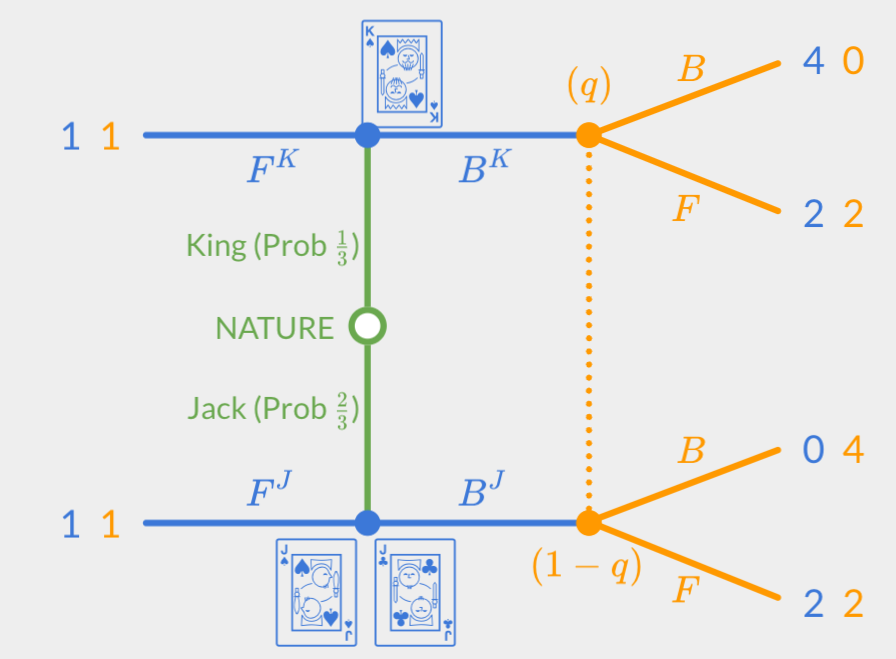
(I’m working on an interactive version, but wanted to publish the notes…stay tuned. Also, enjoy the fun cards in the diagram.)
To analyze this game, first notice that a King always wins; so Player 1 will never fold a King. Therefore the two possible pure strategies we’d need to consider are $\pone{B^KB^J}$ (bid all the time) and $\pone{B^KF^J}$ (bid with a King, fold with a Jack). Let’s see if either of these could be part of a PBE. (Spoiler: nope.)
Suppose Player 1 was playing $\pone{s_1 = B^KB^J}$ (bid all the time). Then when Player 2 has the move, he thinks there’s a $\ptwo{q = {1 \over 3}}$ chance that Player 1 has a King; so his expected value of bidding is \(\ptwo{\mathbb{E}[u_2(B\ |\ q = \tfrac{1}{3})] = 0q + 4(1-q) = 0 \times \tfrac{1}{3} + 4 \times \tfrac{2}{3} = \tfrac{8}{3}}\) Since this is higher than the payoff he gets by folding, he’ll bid ($\ptwo{s_2 = B}$). But if Player 2 bids all the time, then Player 1 would want to fold if she’s holding a Jack, contradicting the assumption that she would bid all the time. So there’s no PBE with $\pone{s_1 = B^KB^J}$.
What about $\pone{s_1 = B^KF^J}$? Well in that case, the only time Player 1 bids is when she has a King, so bidding reveals she has a strong hand ($\ptwo{q = 1}$); so Player 2 should fold ($\ptwo{s_2 = F}$) if Player 1 bids. But, if Player 2 folds after any bid, then Player 1 should bid no matter what; so there’s also no PBE with $\pone{s_1 = B^KF^J}$.
In short: there is no pure-strategy PBE. So, let’s look for a mixed strategy.
Intuitively, since we know Player 1 will still always bid with a King, and we know that Player 2 cannot be playing a pure strategy, we have to look for a mixed strategy in which Player 1 sometimes bids a Jack, and sometimes doesn’t, done with exactly the probability to make Player 2 indifferent.
First off, what value of $\ptwo{q}$ will make Player 2 indifferent between bidding and folding? By our previous logic, it’s got to be the value of $\ptwo{q}$ that sets \(\ptwo{0q + 4(1-q) = 2}\) which turns out to be $\ptwo{q = {1 \over 2}}$. By Bayes’ rule, we have \(q = \frac{\text{Prob\{Bid | King\}} \times \text{Prob\{King\}}}{\text{Prob\{Bid\}}}\) Note that the numerator is $1 \times {1 \over 3} = {1 \over 3}$ (i.e. one third of the time Player 1 is dealt a King, and she always bids with a King). So in order for $q$ to be ${1 \over 2}$, we need \(\frac{ {1 \over 3} }{\text{Prob\{Bid\}}} = {1 \over 2} \Rightarrow \text{Prob\{Bid\}} = {2 \over 3}\) So, Player 1 needs to bid 2/3 of the time – for example, adopt the strategy “Bid the King, fold the Jack of spades, bid the Jack of clubs.” That way, she’s bidding 2/3 of the time; and half the time she bids, it’s a King!
Now we’re almost there. We have Player 1’s strategy, as just described (bid King, mix Jack 50/50). We have $q = {1 \over 2}$. Now we just need Player 2’s strategy to make Player 1 indifferent when she has a Jack, so that she’s willing to mix.
Suppose Player 2 bids fraction $p$ of the time. Then if Player 1 bids a Jack, her expected payoff is $0p + 2(1-p) = 2-2p$. If she folds the Jack she gets a payoff of 1. So she would be indifferent if $2 - 2p = 1$, or $p = {1 \over 2}$. In short: in order for Player 1 to sometimes fold a Jack and sometimes not, Player 2 must fold half the time.
Putting this all together, the PBE of this game is:
- Player 1 always bids with a King, and bids with a Jack with probability ${1 \over 2}$
- Player 2, if Player 1 bids, bids with probability ${1 \over 2}$ and folds with probability ${1 \over 2}$
- Player 2 believes that, if Player 1 has bid, she has a King with probability $\ptwo{q = {1 \over 2}}$
Finally, let’s confirm that Player 1 really does want to bid with a King: given Player 2’s strategy, her expected payoff from bidding a King is ${1 \over 2} \times 4 + {1 \over 2} \times 2 = 3$, which is higher than the payoff of 1 she would get from folding.
Reading Quiz
That's it for today! Click here to take the quiz on this reading.